|
Operation Makesafe is a national safeguarding initiative designed to raise awareness of child exploitation and protect vulnerable children. Our primary aim is to identify exploitation at the earliest opportunity and ensure children are safeguarded from harm.
The initiative works by empowering both the general public and those working in key business sectors to recognise the warning signs of child exploitation and to feel confident in reporting concerns to the police.
Evidence from both local and national cases shows that child exploitation can occur in everyday environments such as hotels, pubs, licensed premises, fast food outlets, and other public venues. These are locations where children and young people may come into contact with offenders or be taken as part of the exploitation process.
Through Operation Makesafe, we are working in partnership with businesses and communities to:
• Increase awareness of how exploitation presents
• Support early identification of risk
• Encourage prompt reporting of concerns
• Ultimately safeguard children and disrupt those who seek to harm them
Child exploitation is often hidden and can be difficult to recognise. Children may not see themselves as victims, and in many cases may be controlled, coerced, or manipulated by offenders.
As a Force we want to improve awareness and vigilance in the community, so we can:
• Identify children at risk sooner
• Intervene before harm escalates
• Protect vulnerable young people
• Support safeguarding and prevention efforts
Child exploitation doesn’t always present in obvious ways. However, there are a number of indicators that should raise concern. Please be alert to the following behaviours or situations:
• A young person in possession of large amounts of cash or expensive items with no clear explanation
• A young person carrying multiple mobile phones, particularly “burner” phones
• A young person being accompanied by older individuals or groups, especially if those individuals appear controlling, intimidating, or under the influence of drugs or alcohol
• A young person who appears lost, disoriented, or out of place in their surroundings
• A young person travelling alone at unusual times, such as during school hours, late at night, or frequently moving between locations
• A young person displaying signs of distress, such as being anxious, frightened, withdrawn, angry, or unusually secretive
• A young person involved in begging or loitering in public spaces
• A young person entering or leaving premises repeatedly with different adults
• Evidence of substance misuse, unexplained injuries, or neglect in appearance If something doesn’t feel right, trust your instincts. You do not need proof—reporting concerns could help protect a child from harm.
• In an emergency, call 999
• For non-emergency concerns, contact the police on 101
• You can also report safeguarding concerns through local safeguarding channels or Crimestoppers anonymously 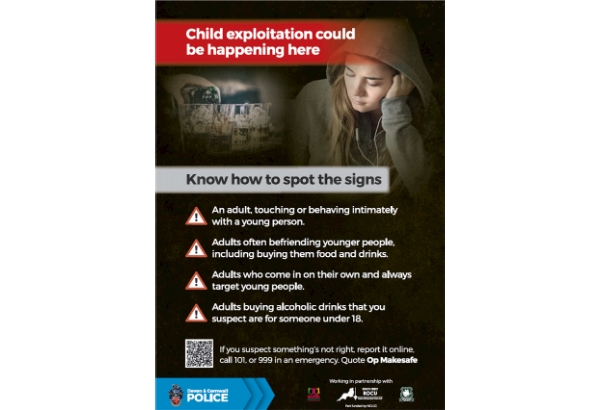
|